
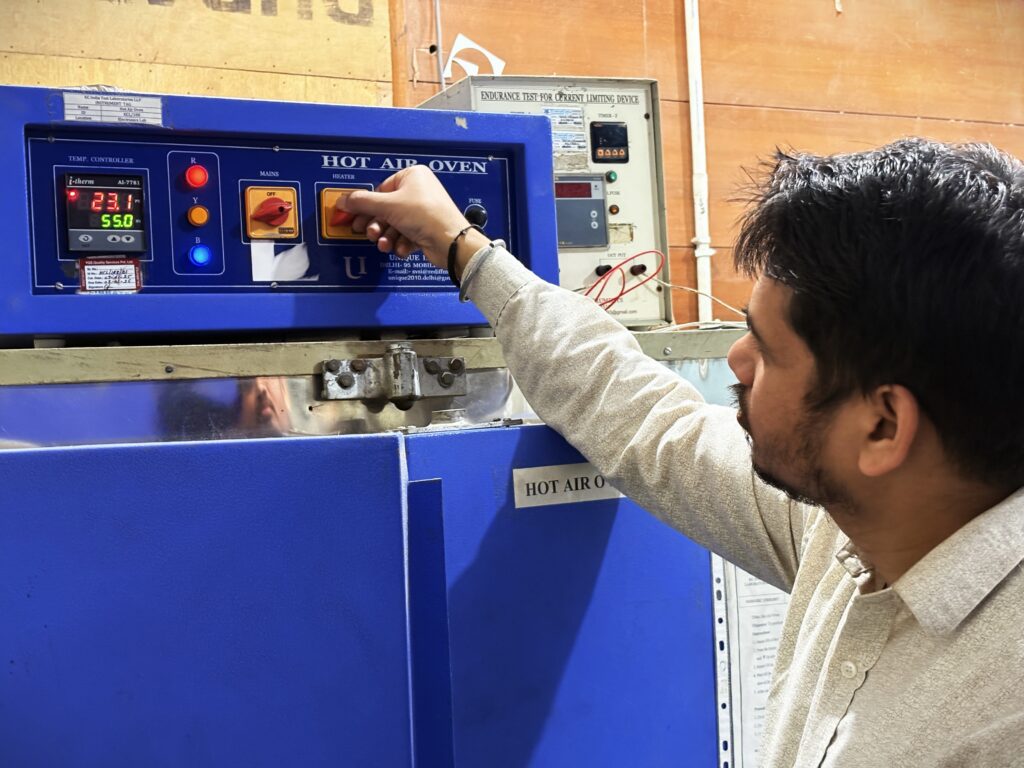
Environmental Testing
KC Test Lab has a state-of-the-art testing facility for Environmental Testing with modern and accurate Environmental Chambers (Humidity chamber with temperature range -60°C to 200°C & Humidity Ranges above 97% and Humidity chamber with dimensions 8x6x6 Feet for large testing ranges), in full compliance with IEC standards. Some of the basic equipment needed for the testing are temperature and humidity chambers, thermal shock chambers, vibration machines, and salt-spray corrosion chambers.
Why is Environmental Testing Required?
Environmental Testing Lab simulates the distinct climatic conditions and mechanical stresses that products are uncovered to in the course of their lifetime. In general, environmental tests exhibit that your merchandise has the build quality to function perfectly, irrespective of what the conditions are.
Key Environmental Conditions Simulated:
Extremely High (+200°C) and Low (-60°C) Temperatures • Swift Variations in Temperature (Thermal Shock) • Blown Sand and Settling Dust • Salt Spray and Salt Fog Corrosion • Very High (>97% RH) or Low Humidity • Waterproofing and Icing • Presence of Corrosive Fluids and Fungus • Dynamic Acceleration and Vibration.
What Do We Analyze in Environmental Testing?
Environmental tests are performed to check the build quality of the product in various types of environmental conditions. During testing, possible weaknesses can be identified and product improvements can be initiated at an early stage. Common anomalies detected include:
- Deformation in dimensions and warping of casing
- Electrical or electronic parts stopping operation under thermal stress
- Break in enclosure seals or structural components
- Ingress of moisture or dust into internal circuits
- Corrosion and pitting over metallic contacts and fasteners
- Failure or degradation of electrical insulation resistance
Products That Require Environmental Testing
- Electrical and Electronic sub-assemblies and PCB modules
- Lithium-ion Battery packs and energy storage systems
- Electric vehicle motors and traction inverters
- Automotive sensors, dash displays, infotainment and cameras
- LED Luminaires, streetlights, and architectural floodlights
- Railway signaling and defense communications hardware