
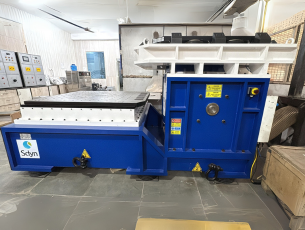
Vibration Testing
KC India Testing Laboratories is one of the best and most renowned Vibration Testing laboratories. Vibration testing is performed to examine the response of a device under test (DUT) to a defined vibration environment. The measured response may be the ability to function in the vibration environment, fatigue life, resonant frequencies, or squeak and rattle sound output (NVH).
Our vibration testing labs are exclusively carried out in closed-loop. By using accelerometers on the shaker and optionally on the Device Under Test, we have high confidence in knowing exactly what energy we impart on your unit. Our controller then compensates in real-time for any changes in the entire system ensuring we achieve the specified, nominal test values. We have a highly customizable vibration table compatible with many different configurations: a shaker head and slip plate. Our systems can accommodate 60 or more data channels and still give you the data right at the end of the test with a formal report following in less than two weeks.
What are Vibration Testing Labs and their Purpose?
In vibration testing, the vibration environment to which products will be exposed in real use is reproduced. Products are tested in this environment to judge their durability or check for improvements. Vibration Testing is performed to examine the response of a device under test (DUT) to a defined Vibration Environment. In general, vibration testing is used to demonstrate a product’s ability to resist dynamic loads without losing critical functional or structural integrity under specified loads. It can be used to identify accumulated stress effects, and the resulting mechanical weaknesses and performance flaws.
Types of Vibration Testing:
Free Vibration: Occurs when a mechanical system is set in motion with an initial input and allowed to vibrate freely.
Forced Vibration: When a time-varying disturbance (load, displacement, velocity, or acceleration) is applied to a mechanical system.
Damped Vibration: When the energy of a vibrating system is gradually dissipated by friction and other resistances.
How to Mount Accelerometers Correctly in Vibration Testing
The mounting of a vibration sensor (accelerometer) directly impacts its performance. To detect faults in machine components, vibration sensors should be mounted in locations that ensure horizontal, vertical, and axial movements are measured effectively:
- Horizontal Measurement: Sensors mounted on motor bearings and pump bearings (velocity in mm/sec Peak or RMS) to detect unbalance and structural rigidity issues.
- Vertical Measurement: Located on motor and pump drive end bearings to detect looseness and foundation problems.
- Axial Measurement: Attached to drive end bearings to detect misalignment between driving motor and fan.
Common Vibration & Shock Tests
- Sinusoidal Vibration
- Random Vibration
- Sine on Random Vibration
- Combined Temp & Vibration
- Accelerated Life Testing (HALT)
- ESS Vibration Screening
- Repetitive Shock Test
- Half Sine Shock Pulse
- Saw Tooth Shock Pulse
- SRS (Shock Response Spectrum)
- Gunfire & Pyroshock Simulation
Vibration and Shock Standards
ANSI C136.31, ASTM D4169, EN/IEC 61373 (Railway applications), EN/IEC 60068-2-6 / 60068-2-27 / 60068-2-64, ISO 16750-3 (Road vehicles), ISTA 3A, 3B, 3F, 3H, and MIL-STD 810G/810H.